Pearson Edexcel · GCSE · English Language
Course version: 1EN0 · Version from Mar 2026
AO4: Evaluate texts critically and support this with appropriate textual…
Full specification wording
Assessment Objectives: AO4: Evaluate texts critically and support this with appropriate textual references
AO4 requires you to judge how successfully a text achieves its purpose and to justify that judgement with well-chosen evidence.
Checked against the Pearson Edexcel 1EN0 specification (opens in a new tab) on .
- Point 4 of 9
- 4 key terms
Study notes
From the checked teaching notes for this specification point.
The idea
AO4 requires you to judge how successfully a text achieves its purpose and to justify that judgement with well-chosen evidence. Begin by identifying the writer’s intention, such as to persuade, inform, entertain or challenge, and the intended effect on the reader. Then select precise references, including quotations, structural features or patterns of language, and explain how each one creates that effect. Move beyond identification by weighing the method’s impact: consider whether an image is vivid, a statistic convincing or a shift in tone unsettling, and explain why. A strong evaluation balances praise and criticism, considers alternative readings and keeps returning to the text as the basis for every claim.
For example: You might argue that a charity advertisement’s direct address is powerful but that its repeated statistics risk overwhelming the reader.
What earns the marks
- Establishes a clear critical judgement about the text’s effectiveness in relation to its purpose and audience.
- Selects precise and relevant textual references, including quotations and references to structure or form, to support the evaluation.
- Explains how specific language and structural choices create effects on the reader.
- Weighs the success of methods, considering strengths, limitations or alternative interpretations.
- Maintains a coherent evaluative line of argument rather than listing isolated observations.
- Uses evaluative vocabulary such as ‘effectively’, ‘convincingly’ or ‘arguably’ to signal critical stance.
Common mistakes and how to put them right
Labelling a technique without judging its effect.
Put it right: State what the technique makes the reader think or feel and how successfully it does so.
Using quotations as decoration without linking them to the judgement.
Put it right: Select evidence that directly supports or complicates the evaluative point.
Offering personal opinion unsupported by the text.
Put it right: Ground every judgement in a specific word, phrase, image or structural feature.
Exam tips
- Turn the question into an evaluative statement you can agree or disagree with, then build your response around proving that case.
- Choose two or three key moments and analyse them in depth rather than listing many shallow references.
- Use evaluative phrasing, such as ‘this is more convincing because’, to develop a line of argument.
Try the lesson
The start of the Assessment Objectives: AO4: Evaluate texts critically and support this with appropriate textual references lesson, made from checked teaching notes for this specification point.
Have a go first
In AO4, what does 'evaluate critically' ask a student to do?
Listen
AO4 requires you to judge how successfully a text achieves its purpose and to justify that judgement with well-chosen evidence. Begin by identifying the writer’s intention, such as to persuade, inform, entertain or challenge, and the intended effect on the reader. Then select precise references, including quotations, structural features or patterns of language, and explain how each one creates that effect. Move beyond identification by weighing the method’s impact: consider whether an image is vivid, a statistic convincing or a shift in tone unsettling, and explain why. A strong evaluation balances praise and criticism, considers alternative readings and keeps returning to the text as the basis for every claim. For example, you might argue that a charity advertisement’s direct address is powerful but that its repeated statistics risk overwhelming the reader. A strong answer earns marks for these points. Establishes a clear critical judgement about the text’s effectiveness in relation to its purpose and audience. Selects precise and relevant textual references, including quotations and references to structure or form, to support the evaluation. Explains how specific language and structural choices create effects on the reader. Weighs the success of methods, considering strengths, limitations or alternative interpretations. A common slip: Labelling a technique without judging its effect. Instead, state what the technique makes the reader think or feel and how successfully it does so. Exam tip: Turn the question into an evaluative statement you can agree or disagree with, then build your response around proving that case.
See it
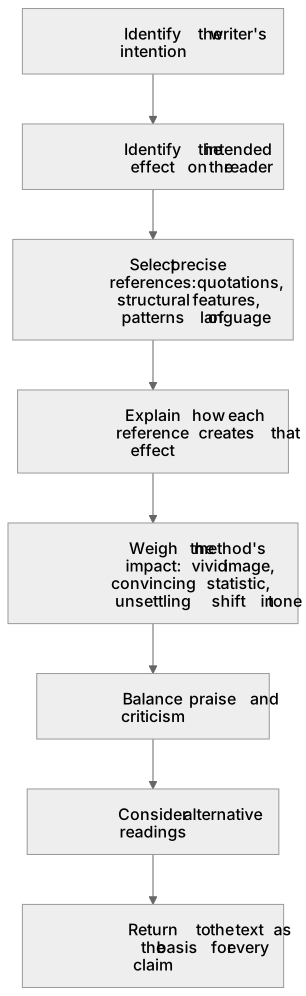
Put it in order
Put these steps in the order they happen.
- 1. Weigh the method's impact: vivid image, convincing statistic, unsettling shift in tone
- 2. Return to the text as the basis for every claim
- 3. Balance praise and criticism
- 4. Identify the writer's intention
- 5. Identify the intended effect on the reader
- 6. Consider alternative readings
- 7. Select precise references: quotations, structural features, patterns of language
- 8. Explain how each reference creates that effect
Key words
Say what each word means before you turn the card.
Critical evaluation
Try answering aloud or in your head before turning the card.
Textual evidence
Try answering aloud or in your head before turning the card.
Writer’s methods and effects
Try answering aloud or in your head before turning the card.
Reader response and purpose
Try answering aloud or in your head before turning the card.
See every definition
- Critical evaluation
- Judging how successfully a text achieves its purpose and justifying that judgement with well-chosen evidence.
- Textual evidence
- Precise references, including quotations, structural features or patterns of language, selected to support the evaluation.
- Writer’s methods and effects
- The specific language and structural choices a writer makes and the effects they create on the reader.
- Reader response and purpose
- The writer’s intention, such as to persuade, inform, entertain or challenge, and the intended effect on the reader.
Label the diagram
Some boxes have lost their names. Pick the right name for each number.
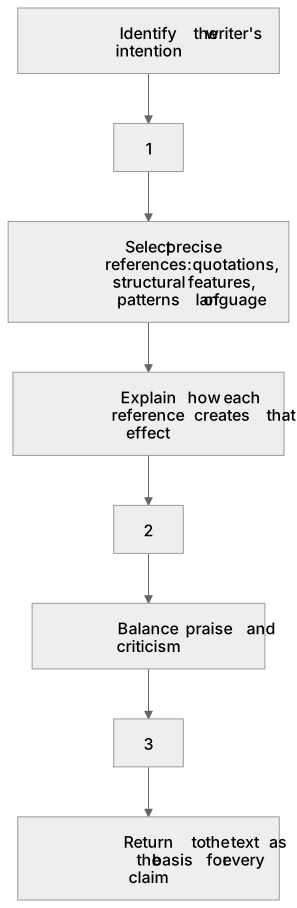
1Box 1
2Box 2
3Box 3
There is more to this lesson
The full lesson goes on to check your understanding and help you earn the marks. Create a free account to carry on, with your progress saved.
A week of Premium from your first lesson · Then the free plan continues · No card, no charge
Test your understanding of Assessment Objectives: AO4: Evaluate texts critically and support this with appropriate textual references
Active recall beats re-reading. Take an instant quiz now to test what you’ve learned and lock it into long-term memory.
A week of Premium from your first lesson · Then the free plan continues · No card, no charge